Yesterday I sketched in the time it took to cook an omelette!
I was chatting in the kitchen while brunch was being prepared. My friends don’t mind me sketching and almost expect me to. The kitchen was full of objects to sketch. I asked for suggestions, and this saucepan was suggested as it was a special gift.
I thought about the everyday objects in the kitchen and looked back through my sketches for some examples to explore today.
The utensils below are from my family home. They were always on the wall inside of the kitchen cupboard. I would describe these as a drawing and not a sketch, as they are more studies and detailed and were completed over a few sessions. This is an example where an everyday object has a special nostalgic meaning attached to it.
The four sketches below are quick sketches of everyday objects that I have no emotional attachment to. They are practical and useful. They are a reminder that there is never ‘nothing to sketch’ and ‘anything is sketchable’.
The final three were part of a commission to illustrate a family recipe book.
I posted it again in September 2017 Father’s Day in Australia.
And here we are in 2025 on Father’s Day. A few things have changed. I still make a yearly trip home to Toowoomba (in Queensland) and now I travel from Melbourne, where I live. The house is sold and the contents gone. Mum has also died and I have more of those special objects.
Here is an added extra sketch from Septemeber 2023. from my wonderful dad’s (1942-1987) shed. now on my window sill . He had a whole wall of these old margarine containers (Dixibell Table Margarine) in his shed full of organised and labelled washers, springs, nuts and bolts etc . I have two and they are still dusty and grimy and I love them.
I thought that I would share the original blog post again. These memories are timeless.
2014
I have a yearly visit home to Toowoomba (in Queensland) from Sydney at Christmas. It is a week or two catching up with friends and family and falling into a familiar routine. This usually includes de-cluttering cupboards and being highly distracted by childhood memories.
It also involves re-exploring my Dad’s workshed in the backyard. It is a step into the past. Dad died in 1987 and although much of the larger machinery and tools are gone, it still has shelves and cupboards of work tools and bit and pieces. Dad was a panel beater by trade and a handyman, inventor the rest of the time . He seemed to have every possible item to fix, nail, screw, clip, polish, cut, drill … The tools are stored in specially labelled containers and drawers or hanging up above the workbench, on the wall. Most of these items are still there and have not been moved.
So much of this is part of my childhood.
This year I decided to draw some more of it. These are all done in watercolour pencil and Lamy Safari Joy ink pen. If a clean out is ever done (hopefully this year) it may not be there next time I visit.
I then drew the wall above the main workbench, over two pages. I was not sure where/if to add colour to the page. I do not need any of them in my life in Sydney, but wanted a memory. That gave me the idea to draw some of the tools on the page. I chose a few and brought them up to the house and drew them over two days.
This is what our dining table looked like New Years Eve – a drawing in progress.
I have no idea what many of these objects are, and the labels are a mystery. It was the job of my brother & I (and Mum to ) to sort through and to separate buckets of nuts and bolts ! I did not inherit my Dad’s mechanical and technical nature, although he also had a creative side (woodturning and pottery). This is not the first year I have drawn tools from the shed. Previous Christmas visits have also provided opportunities. I think I am done now.
2011
2010
A reminder that those everyday object can be precious emeories.
This week’s blog post is the sketches from this week.
Some very sketchy ones, done quickly, the commuters. Slightly longer sketch during a lunch break. The watercolour pencil sketch of my boots did not take long as I have sketched my shoes many times before and know angles to look for.
An experimental video of sketching on location in a local park.
I usually stand up and sketch, but sat on the ground this time to use my MOFT iphone holder to leave my hands free to sketch. It was precariously balanced on my backpack on the grass. There was a picnic table nearby that I could have sat at, however it was too far away to see the detail of the tree.
I talk through the video explaining what I am doing. You can also hear the lorikeets, currawongs and magpies in the background.
The first video is 10 minutes in real time Further down the page is a 30 second time lapse video.
Below is a list of the Faber Castell watercolour pencils that I took out of my sketchkit to use. I am not sure if I used each in this sketch. I did not need to and could have used fewer, I could have also sketched it in blue or red!
Dark Sepia – a lovely colour, between a dark brown and grey
Burnt Ochre
Warm Grey II
Cool Grey IV
Payne’s Grey
Grass Green
Burnt Umber
I am using my Kuratake (Zig) Medium watercolour brush in Moleskine watercolour sketchbook.
and here is the 30 second video.
If I sketched this another time I may have approached it differently. I make it up each time, within my own processes and methods.
I would like to video more outside sketches. Next time I will find a subject that lets me have more control over the angle, shadows, page etc.
Let me know if you have any questions about this.
classes
I have a few in person classes coming up if you are in Melbourne.
Nature Sketching with Watercolour pencil in Royal Botanic Gardens. Sat, 6 Sep 202510:00 AM – 12:00 PM Book HERE
The Johnston Collection, Georgian House Museum Summer Sketching with Alissa Duke Saturday 8 Nov 2025, 2:00 PM – 4:00 PM Book HERE
Pad Thai Noodles – leftovers – noodles and the lemon Sketched in watercolour pencils in 13 minutes.
Below are
the finished sketch
photograph of my plate
the 13 minute video with voiceover, describing my process as I go
the colours I used
The FaberCastell Albrecht Durer watercolour pencils I used, with a Kuretake (Zig) Medium waterbrush.
Ivory
Burnt Umber
Cool Grey IV
Payne’s Grey
Brown Ochre
Light Cadmium Yellow
Cream
Light Yellow Ochre
Grass Green
Version One and Two. I filmed in time lapse with voiceover. I then found out that time lapse videos do not have an audio option,I ate my dinner and then resketched it from the sketch.
This took 13 minutes to sketch and hours figure out how to move it into my blog.
I have writtem down the step, and next time will be a lot smoother, with less tears.
Let me know if you have any questions, or any other sketching you would like me to try and film.
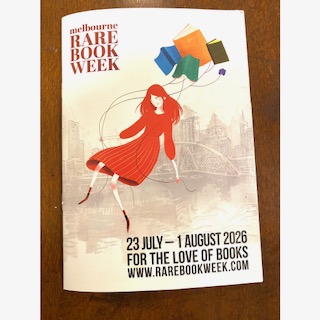
It was only a week ago that Melbourne Rare Book Week and then Melbourne Rare Book Fair finished.
The Melbourne Rare Book Fair returned once again to Wilson Hall, The University of Melbourne. It is the major annual book fair of ANZAAB and one of only a few rare book fairs held in the Southern hemisphere. Now in its 53rd edition, the Fair again featured rare and wonderful books, manuscripts, ephemera, prints (and much more) from the best rare book and antiquarian dealers across Australia and New Zealand and from overseas.
This is a gathering of buyers, sellers and lovers of books not to be missed. Whatever your tastes may be, you are sure to find a rare and interesting book, print or piece of ephemera to add to your collection.
Thursday 31 July 6:00-9:00pm Friday 1 August 10:00am-5:00pm Saturday 2 August 10:00am-4:00pm
Bookings are not required for the Rare Book Fair and Entry is Free.
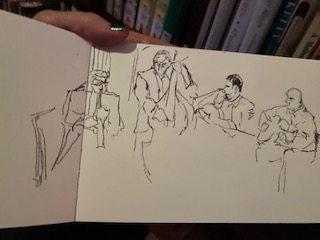
I attended the Fair over the three days, sketching on location. My sketches are used by Melbourne Rare Book Fair in their promotional and advertising and social media. It is very different from my sketching at MRBW talk, where I sit at the back of the room and sketch for an hour. At the Fair, people are constantly moving as they browse chat and sometimes buy.
Here are some from the 18 pages of my sketchbook I completed. For the first year, I filled my first sketchbook and started into a second.
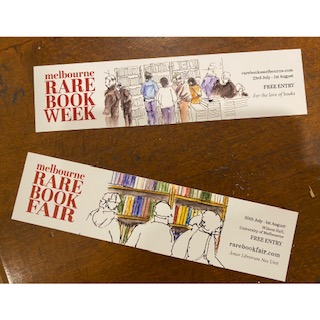
My sketches from previous years were the branding for the Fair and they were everywhere!
Two bookmarks double sided
Posters – A3 & A5
The stickers that sealed a bag after you made a purchase at the Fair.
and most amazingly on the wall in the entryway of the Fair, next to the cloak room. My sketch was used last year and it came as a total surprise when I arrived. I was sent a photo in advance but was still amazed to see MY art on a wall !
Speakers: Wallace Kirsop, Judy Donnelly and Des Cowley
The recently published From Convict Printers to Book Arcades completes the three volume History of the Book in Australia, a project begun in the 1990s. It takes its place alongside other projects emanating from Britain, France, America, and Canada that have sought to document global histories of the book. Join the volume’s editors Wallace Kirsop and Judy Donnelly in conversation with Des Cowley as they discuss the genesis of the Australian project, how they succeeded in bringing this significant publishing project to fruition, and their thoughts on its contributions to international scholarship.
Presented by: Rare Books Melbourne in partnership with Melbourne Athenaeum Library at The Melbourne Athenaeum Library, Level 1, 188 Collins Street, Melbourne
I may add colour to the books at a later date. This was the sketch completed on location in the 60 minutes of the talk.
Come into Moominland
Speakers: City of Melbourne Children’s Librarians
Bring your children along to experience the world of Moomintroll, the Snork Maiden and Snufkin as conceived by Tove Jansson, a multi–talented Finnish author, illustrator and sculptor. Since 1945 in Swedish and 1950 in English, the Moomins have captivated generations of children. They have featured in storybooks, picture books, comic strips, animated cartoons and iPad apps. Our children’s librarians will guide your children into the idyllic Moominvalley to share the adventures of the Moomin family and their friends.
Original editions and collector’s Moomintroll books on display.
Presented by: City of Melbourne Libraries
at North Melbourne Library, 66 Errol Street, North Melbourne
Artist EV Ratnam began keeping travel diaries in 1995, and has since developed a keen interest in artists and writers whose travels have informed their work. As well as discussing some of these, she will also present her own travel diaries, and reflect on the ways in which, through memory and imagination, they are linked to the imagery in her prints, drawings, and artist books. At the end of the session, there will be an opportunity to view her diaries close – up, and engage in a dialogue on travel, writing and art.
Presented by: WriteHeart Books at the Kathleen Syme Library and Community Centre, Multipurpose Room 2, 252 Faraday Street, Carlton
Tim Hogan spoke on sports history with MCC Library’s own Trevor Ruddell. Which collections were encountered and which collections wereused in the course of their work? Where are the hidden gems of sports history? What rare treasures have been uncovered since we last met and what projects are people working on this year?
Presented by: Melbourne Cricket Club Level 3, Members Stand, Melbourne Cricket Ground, Jolimont
It is always a joy to arrive early and chat to the MCC Librarians and sketch some books !
Speakers: Sue Louis in conversation with Professor Emeritus Chris Browne
All of us who enjoy reading generally own at least a few books. For most, public libraries also offer an invaluable source of reading pleasure. But how does one go about collecting a library of one’s own? Join us in a conversation with Sue Louis to share in her love and enthusiasm for books, and to see how one lady from East Melbourne put together a remarkable collection of fine books with her late husband, Professor Emeritus Bill Louis. Sue will share with us some notable examples and personal favourites from her impressive library.
Presented by: City of Melbourne Libraries at East Melbourne Library Meeting room, Level 1,122 George Street, East Melbourne
The origins and cultural context of the Danse Macabré
Speaker: Elizabeth Milford, RACS Archivist
The Dance of Death flourished in fifteenth century Europe but what were its antecedents and why was the theme so pervasive? The first Dance of Death mural was painted on a wall in the cemetery of Les Innocents in Paris, and was a catalyst for other Dances of Death, most importantly the series of woodcuts by Hans Holbein, printed in 1524 – 1525. Three centuries later, his work was still being copied, and the theme was embraced by composers such as Franz Liszt and Camille Saint – Saëns. This talk will discuss its origins, and specifically the fascination with death and decay that became ubiquitous in the late Middle Ages.
Presented by: Royal Australasian College of Surgeons Council Room, 250 – 290 Spring St, East Melbourne
I was invited to arrive early and sketch in the Historical Collection.
Literature lovers know Samuel Johnson as the dictionary maker and subject of James Boswell’s biography. Most know him as a poet, an essayist, and the founder of English criticism. Much of this work is still in print, but the addicted collector seeks out Johnson’s hidden, often anonymous dedications, prefaces and editorial work, the titbits that are hard to find. John Byrne has been collecting Johnsonian material for 60 years. He will show rare material from his library and share stories about where and how he found it.
Presented by: The Johnson Society of Australia at Kathleen Syme Library and Community Centre, Multipurpose Room 1, 251 Faraday Street Carlton
How Fashion Gave Birth to Art Deco: Fashion illustration evolves into a new style of art
The Art Deco style first emerged among a group of young artists in Paris who wished to rejuvenate the depiction of French fashion. This development evolved into Art Deco in the years around the First World War. It came to a peak at the Exposition Internationale des Arts Décoratifs in Paris in 1925. Professor Browne has assembled a collection of original French fashion magazines and images from the first half of the 20th century. He will share some of these with you, and show how the developments in fashion illustration led to the full flowering of the Art Deco style.
Presented by: City of Melbourne Libraries at East Melbourne Library
I arrived early at State Library of Victoria for the first event and did a few sketches outside.
Judging a Book by its Cover:Fine bindings from State Library Victoria’s Rare Books collection
Speaker: Daniel Wee
We’ve all heard the saying “never judge a book by its cover”– but when it comes to the world of fine bindings, aesthetics are everything. From luxurious leathers to bespoke intricate gold tooling, fine bindings invite us to engage with books on another level. Judging a book by its cover, in this case, is not shallow–it is a way of honouring craftsmanship, context, and the enduring power of beauty in bookmaking. Join Daniel Wee, Senior Collection Curator, History of the Book as he shares a selection of beautiful fine bindings from the Library’s Rare Books collection.
Presented by: State Library Victoria at State Library Victoria, Digital Laboratory, 328 Swanston Street Meet at the Swanston Street Welcome Zone
Picturing the World of Jane Austen: An examination of the illustrations of Austen’s novels
Jane Austen has painted in our imaginations a vision of the English world that she inhabited over 200 years ago. The original editions of her six novels had no illustrations, but from the late 19th century, many artists have attempted to enhance her words with pictures drawn from their own imaginations. Professor Browne will discuss a selection of these images, mainly drawn from his extensive collection of illustrated editions of Austen. He will ask the audience to judge whether a picture is worth a thousand words of her writing in this, the 250th anniversary year of her birth.
Presented by: City of Melbourne Libraries and Jane Austen Society of Melbourne at East Melbourne Library, Meeting room, Level 1,122 George Street, East Melbourne