sketchbook travel journal : the practicalities

 
 Recently I reflected on my blog on the realities of sketching and drawing in a sketchbook while travelling, and on how and what/how I would draw. On my holiday in London and Barcelona, I could put my theories into practice and test them to see what happened in reality.
 
 I also had a chance to experience the realities of the act of sketching while travelling. I now have the opportunity to reflect on the practicalities of sketching . This is what I experienced and will be vastly different for everyone, but might give some insight.
 

                               PRACTICALITIES – MY PENCILS

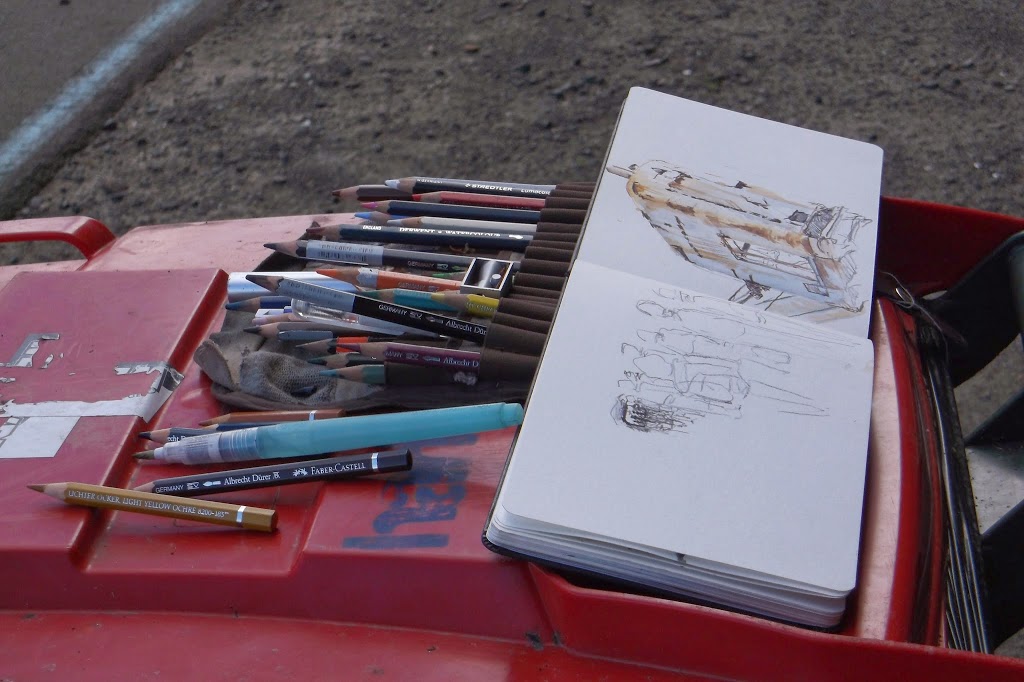
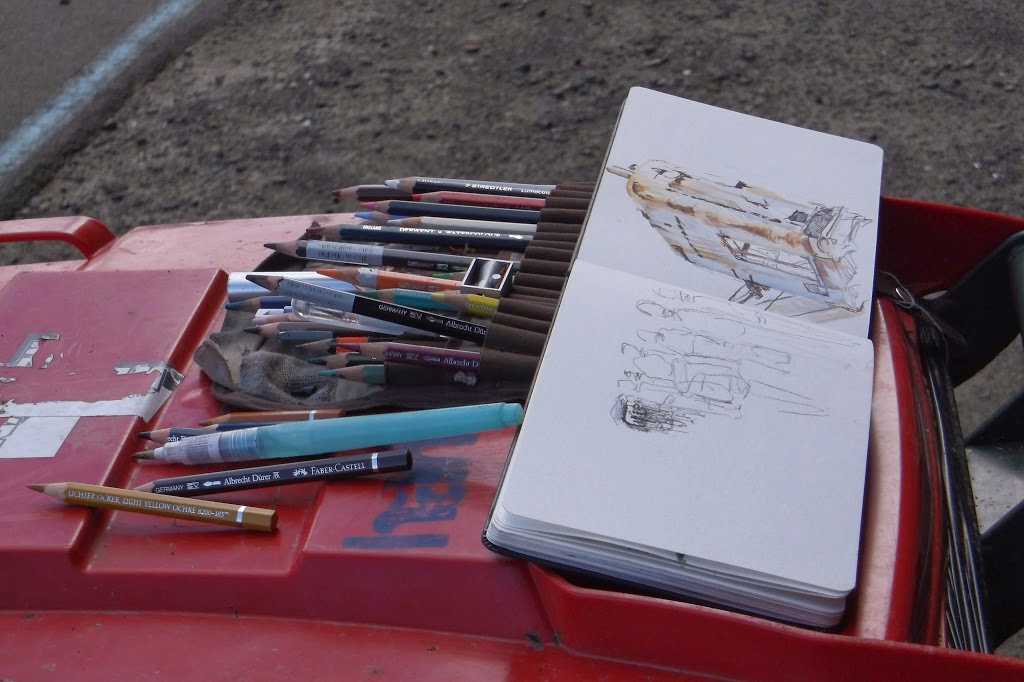
I have a customised pencil wrap for my watercolour pencils. Read and see the story of its creation. This was my opportunity to test it out while travelling. I found that the design was great for all of my on the spot sketching, for example leaning up against a wall, at cafes or on the plane. I can have it out in front of me and see all colours at once.   I only lost three pencils in London. (Light Chrome Yellow had to be replaced twice – why was it jumping out??). But losing pencils (and erasers) proved an excellent excuse to visit two amazing art shops that I knew of. They are both traditional shops that are a joy to browse through – lots of wooden drawers with papers, paint pigment for grinding and other Cornelissen & Son Artists’ Colourmen in Bloomsbury and Green & Stone of Chelsea. Heaven


day before London- a lot dirtier and worn now

Sharpener pocket
 
I had asked for pockets for my eraser and my pencil sharpener.
  
Sharpener – worked brilliantly. I found that I did not take the sharpener out of the pocket, but put the pencil into the sharpener while it was in the pocket.  The pocket did fill up with pencil shavings, but it worked really well. I think we may make the next version using a sharpener with a container attached to it. I think Staedler make one

 
Eraser  – did not work. I broke my eraser into smaller pieces and would put one piece in the pocket. However, they fell out and I lost so many erasers throughout London in the first week. Very frustrating. But then, in Barcelona at the Urban Sketching Symposium, we were given lots of freebies by the sponsers. One was a mechanical eraser – It has solved all my problems. And I can put it one of the pencil slots in the wrap.


Tombow mechanical eraser
 
 
PRACTICALITIES – OPPORTUNITIES  TO SKETCH


I slept with my sketch book next my bed (or is that in my bed ??), so that in early hours of the morning (we had long summertime hours in the UK) This was in London in the first few days.

This photo was taken in Sydney, but gives you the idea of how I sketch at the table. Please note  I usually put my pen down when eating. My pencil wrap would be on my lap or on the table

OTHER OPPORTUNITIES

  • As a passenger in planes, trains and cars. This worked best when I knew how long the journey would take 
Sydney Airport


a quick sketch and slow drawing on the long plane journey

  •  In queues. There are plenty of those and some of them very long
 
on the Tube  no time to sketch! the trains come so regularly

at the check in desk at Barcelona airport. the line moved so fast !!

 
  • While waiting  for people. When a travelling companions are texting, emailing, resting, shopping. I usually asked for 1/2 hour “meet back here”.  I then had a known timeframe. My travelling companion knew that this was a sketching holiday for me and was prepared to these moments.


and I sketched everywhere 


Albert Memorial


The Tower of London
 
 
Trafalgar Square

Barcelona


A closeup of how I hold my sketchbooks and pencils. My sketchbook is balanced ontop of the pencilwrap, so that I can easily lift it up to gain access to the pencils. I also hold a selection of colours I am using in my sketching hand. It sounds awkward but it works for me


outside of St Paul’s Cathedral

outside of St Paul’s Cathedral
 
I would love to hear others experiences when travelling and any hints and tips. What do you do ?


If you are in Sydney. I am talking about my travel sketchbooks at Erin Hill Sketching  sketchclass on Oct 26 . Book in and I will see you there !


sketchbook travel journal : the reality

On Thursday, October 11, 2012 I wrote my thoughts on creating a travel sketchbook for KateJohnson’s wonderful Artist’s Journal Workshop blog. (If you are not familiar with it and the book you should read it !)

I reposted my original post on my blog in August this year.

I had written that blogpost to gather my thoughts “on paper” on how I would approach my own travel sketchbook. I had entered the 2013 Sketchbook Project and chose the theme : Travelogue. At the time I decided to revisit my 2007 holiday to Paris, as if I was there, drawing as much then as I do now ! My sketchbook is based on my diaries, photographs I took and where I thought I would have drawn at the time, as well as souvenirs I bought. Although this is created in retrospect, all the time I thought how would approach future travel sketchbooks.

The journal can be viewed here
Travelogue Paris 2007. Over the 18 double pages of the Sketchbook Project I experimented with composition, lettering, maps and came to some  conclusions about what and how I wanted to try and capture in my travel sketchbook journal.

In July this year I had three weeks holiday travelling to London and Barcelona, where I had the opportunity to put all of my thoughts and ideas in practice. I filled two Moleskine watercolour sketchbooks. This post is to review what worked (most things) and what didn’t (a few things) in reality. I knew what I wanted to try and achieve and what was important to me on my holiday in my journal.
 
I am so incredibly proud of my holiday sketchbook journals  (see them on flickr: London and Barcelona) and each time I look at them (for example, to write this,) I relive my holiday and it gives me immense joy to see the pages. They are a unique holiday souvenir that will be with me for a long time.

Below are my original theories from the Sketchbook Project  and then the reality of how it worked when I was actually travelling, with examples

· it will be a combination of on the quick on the spot sketching and more detailed drawings

This worked so well – and gave life and an individual feel to my sketchbook.


on the plane Sydney to Hong Kong. a very quick sketch of people queuing for the toilets after a meal. A drawing of my dessert (a delicious ice cream bar) . I drew the ice cream for a while then as it began to melt, I ate it, making sure I opened the packet in an inconspicuous section. I then kept it after the attendant cleared the meals away and finished drawing it then


I use watercolour pencils and Lamy Safari Joy ink pen. I can combine these and have a few different styles of drawing that suit different opportunities, the time and place or my mood. The above sketch shows the two extremes.


· leave first page or two of each day blank – at end of day I could draw maps, streets walked that day, rail/metro routes caught.

I wish I remembered to do that each day . I often forgot to leave the first page blank and would not remember until I had started the first sketch . I would then leave the rest of the page free. Next time I will turn to the next blank page the night before and write in pencil on the page LEAVE BLANK. Two pages could easily be left for this

· draw objects such as tickets, souvenirs, food, headings also at the end of the day in my hotel room. There is time and space to draw. If there is a good view from the room, I can draw it everyday


view inside the hotel room and also looking out the window. This was drawn over two or three sessions, just a bit at a time


the leaf and seed were picked up in Hyde Park on this day. I sketched Royal Albert Hall on the spot and then left the space and drew a rough outline of the size and placement of the leaf and drew if at the hotel over the next day or two before it wilted


I stood across the street to sketch the printshop and then drew the books on the plane on the way home.

I had the feathers for a week and then realized that we were flying home the next day and could not take them back to Australia. Three feathers in one night !
   

I drew objects A LOT less than I thought I would, especially since that is a style of drawing I do a lot at home and get a lot of enjoyment out of. In reality, if I was working (that is the wrong word !) on my sketchbook in the evening, it was adding my notes, finishing off sketches by adding a bit more colour or line.

I was travelling with my mother and she was very patient with my sketching, and also appreciated quiet time for herself, while I sketched.


I was also very tired at the end of each day. It is part of being a tourist, walking and seeing a lot. We had 28 degrees in London each day and long summertime hours


· MAPS.
If I colour the roads or areas between the road on a map I can match them with other colours I have used on the page, bringing it all together. 


the blue and green of the land and river on the map, matching the sky
 
 
The lettering on the page matching the blue of the Serpentine


just the basics


I am really happy with this combination
 

I have never been comfortable with maps I tried to add – too many streets, too messy  looking. But I do want to include maps of my travels. I experimented with a few different alternatives in my Paris Sketchbook project. In the end I have a basic mud map. I have included  the streets we walked down and different types of transport. I did not do a map for everyday – probably only eight in the whole book, but I was pleased with those that I did. They are a gentle reminder of how we get where we went

·  leave lots of white space – I can always fill it in later if it looks too sparse.

as mentioned  , I did not do enough of this .

·   write commentary about how I feel, think, react to things, smells, places but not too much. I will probably keep a separate diary.


I want to write too much and have to make decisions about what to include. Often the sketch tells the story and only a few other notes were added.

I feel as though I did not write enough on the moment of thoughts and feelings. It was not often the right time and place. Often I scribbled some thoughts in pencil on the page and left a block of space around it to expand on it later (in the evening at the hotel).

I still want to include something of the history or description of the place I am. But where to stop? In the end, my sketchbook journal is for me, not a history lesson, so I just need reminders of it’s place and importance in history. And there is SO much history in London. I was overwhelmed by it.


· buildings and vistas

I know how I draw at the moment. I am at ease drawing objects, food, paper. I am not so good at buildings and vistas. But architecture is an important feature of a city or town and so I want to include it , the trees, roads, sky. I have been considering how it is best for me to capture a scene with these in it. I want to create a little vignette., with a little character and insight, but not too much

-just try an draw a section

-leave the top, bottom or sides unfinished.- lines drifting off

– only colour some parts  


· don’t try and fill the page – only use part of the page


I

filled the page in the vast majority of the time -so much to draw !!!


don’t try and get caught up in the detail and try and leave this to a ” close up ” drawing later if I get the chance


Writing this has helped me think about what I have learned about my sketching and myself when travelling. I know that sketching brings me do much pleasure. I hardly took any photographs and when I did they were of people (and then there are those 20 photos of squirrels for reference photos for drawing at a later date).

My art is growing and slowing evolving as I meet other sketchers, go to workshops. These travel sketchbooks seem to be the culmination of a series of events . It is an exciting journey in itself.

If you are in Sydney. I am talking about my travel sketchbooks at Erin Hill Sketching  sketchclass on Oct 26 . Book in and I will see you there !


USK Barcelona DAY 3 Florian & Arno

I have written about my other Barcelona Urban Sketching workshops  .
 
 
All of my Barcelona sketches are on flickr 

 
This was the final workshop of the Urban Sketching Symposium on the Saturday morning. It was Barcelona Perspectives: Percepting and drawing Architecture (Workshop J)
 
Location: Caixafòrum

“You always have to express what is there to see – but above all you always have to (and that’s far more difficult) see what is there to see.” (Le Corbusier, famous architect, in a speech to students, 1962)
Starting from this quotation, we want to teach the participants to see correctly, which – in the end – means to draw correctly. The workshop is about drawing architecture correctly. It is a beginner’s or advanced workshop.

Sample Exercises

We are using a frame that represents the sheet of the paper. We make sure about our position towards the building we’re going to draw with preparatory drawings. Walking through the city, we’re mostly in a perspective relation to its buildings. A grid tells us about spatial shortening through perspective. With the grid, we’re able to transfer the correct proportions. The pencil can be used to find the horizon, which is important to establish the vanishing points onto the paper. The frame and the grid (and far more other drawing supports) will be attached to a script we hand out to every participant.

Learning goals

  • Learn how to see correctly through tutorials about perception, image plane and common perspective drawing.
  • To develop a feeling for space and proportions.
  • Knowledge about the dependence between viewpoint, angle and composition.
  • Perspective skills with 1 and 2 vanishing points.
  • Get to know architecture through drawing
 
 
We all caught the Metro to the Caixafòrum and had a short walk the amazing Mies van de Rohe building. It was originally designed and built as the temporary German Pavilion for the Barcelona exposition (often called the Barcelona Pavilion) in 1929. There is now a 1986 reconstruction  built on the original site.
 
I knew nothing about the building, although I had heard of the architect.  It is an important building in the history of modern architecture, known for its simple form and its spectacular use of extravagant materials, such as marble, red onyx and travertine.
 
I have included a photograph to give you an idea of its beauty and simplicity. You can read much more about this building at its website http://www.miesbcn.com/en/outside.html


The clear plastic sheet with grid marks
 attached to our workshop notes

 
           a page from the workshop notes, showing how to use the grid
 
The Workshop began with an explanation of use of the grid and measuring from vanishing points. The first position that we sketched from had two vanishing points. Our page was to include the entire building from end to end. This is so very different from my usual approach to drawing buildings. I usually do not draw the entire building and also having disappearing edges that fade away.
 
This workshop was the most challenging for me. The other workshops had pushed my boundaries and opened my eyes to new ways of thinking and sketching. But here, I was way out of my comfort zone. I found it very “mathematical” , and my brain and body freeze when maths becomes involved in anything in life! So I really had to try very hard and often remind myself to relax and not stress.


This was made so much easier, as one of the other participants was Sue Pownall, who had been a flickr & facebook friend for a while. We finally got to meet and could talk and laugh our way through this workshop. Here is a link to her review of the day http://www.suepownallartist.co.uk/1/category/uskbcn2013d5d50d5e97/1.html
 
I made a note in my sketchbook that it took me 25 mins to get the first 4 lines down on the page. “
 
          Panic – horizon ? agghh were was the horizon? are we just below it , yes? no?
 
It then to 10 minutes to get the next two lines
 
Over an hour later I had 24 lines/marks in the page. Half of these were wrong as Sue & I had changed our comparative measuring system halfway through. Florian and & Arno were VERY patient instructors
 
Sue Pownall & I showing off our completed sketches at the end of the Workshop

 
The second sketch was a lot easier as it only had one vanishing point. I almost felt like I knew what I was doing !

Sue watching Florian as he gave a demonstration of the sketch

Florian explaining concepts


USK Barcelona DAY 2 Richard Alomar

I have written about my other Barcelona Urban Sketching workshops  .

http://www.alissaduke.com/2013/09/usk-barcelona-day-2-barry-jackson.html Barry Jackson
 http://www.alissaduke.com/2013/09/urban-sketching-symposium-day-one-pm.html Marc Taro Holmes
http://www.alissaduke.com/2013/08/urban-sketching-symposium-day-one-am.html Luis Ruiz
 and I have one more workshop to write up –

All of my Barcelona sketches are on flickr

This one is Sketching Urban Place: People, Space and Street (Workshop G)  with Richard Alomar – It was very entertaining and very educational too !

Instructor: Richard Alomar (New York, USA)
Location: Plaça Reial

Workshop description

Urban spaces are designed by architects, landscape architects and engineers and, for the most part, used and experienced by non-designers. These manmade spaces have been conceived as “Places”. More than walls, streets and trees, they are outdoor rooms for people to move, talk, see and experience: They are the “Place” where life happens.

Sketches and sketchbooks can be used as a way to record these “Places”, beyond the traditional perspective cityscape or ornamental object drawing. Regardless of skill level (something that may take a while to develop) a sketcher can begin to experience “Place” and compose richer, more personally meaningful drawings by understanding the role of spatial structure, personal recollection and observation in the sketching process.

The workshop is structured around 3 activities:

  • Connect: Walk around the space. Understand the patterns, forms and urban elements, including people, void space and structures. 
  • Collect: Record your impressions of the space informally through words, mental mapping, thumbnail sketching, sequence sketching or other “reportage” formats.
  • Compose: Soak it all in. Talk it over with another sketcher. Start to sketch the space as a “Place”: A record of your experience of it. (This can be done in groups of 2 or 3 if needed).
  • Learning goals

    Student will:

  • Learn the spatial components of urban space.
  • Learn various sketching techniques to record initial impressions of “Place”.
  • Understand how to frame and compose a sketch to reflect their individual impressions.
  • Share with others their impressions and techniques.
  • Strengthen the importance of individual expression in sketching


PART ONE

“quick!  quick! quick ! ” (it was a fast paced workshop)
“1 pencil , 1 sketch book – what‘s that in your hand ?–a second pencil – put it away!” 

We walked along the street  and told to stop, draw a Thumbnail square in sketchbook . then have 30 seconds to draw the streetscene  we are looking down

wow !  But after a few of these, my mind started to get into thinking  and seeing in that mode. So instead of spending the first precious 15 of the 30 seconds in a “mind freeze” when we stopped, I could look up and see the street scenes as major shapes and lines and shadows. I started to learn to see what is important. We also added notes around the thumbnail sketch – street names, feelings, colours of buildings etc
We repeated this with two minute sketches 
We then looked at the difference between two  sketches how much difference between the 30 sec and the two minute sketch? how much more or less was capture the second time ?  


By the end of our walk we had captured some spaces and views of our journey in a series of quick sketches. Amazing

PART TWO

Things got interesting as we turned into La Rambla, a  tree-lined pedestrian mall stretching for 1.2 kilometers . It is crowded, busy and tourist packed
I promptly got separated from the rest of the group, with one of the other participants (and also instructor) Fred Lynch. We did have a map of the proposed route of the day,  and we walked up and down through the crowds and after 20 mins decided to write off the rest  of the  workshop and head back to the start. At the moment we looked up and there they were !!!

The group were working on a session on interpreting La Rambla in words and sketches 

This was easy as we just been discussing our thoughts of La Rambla ( they were not good thoughts )
 
 
PART THREE
The last part of the day . In the square – an urban space 


My takeaways – (these may not necessarily have been Richard’s aims of the day!)
 
  • The amount of information that you can capture in a sketch on a page in two minutes –

  • There is always something to draw (I am a great believer in this )

  • Thumbnails- love this idea but always forget to do it, I should prepare a page


USK Barcelona DAY 2 Barry Jackson


 I have written about the first two workshops I attended.
DAY 1 AM Luis Ruiz
DAY 1 PM Marc Taro Holmes

I registered for workshops that would assist and build my urban sketching . I took workshops that would push me past just “drawing a building on a page” . I want to capture the moment or to tell a story. So Barry’s workshop description seemed to fit that  – and it did !

DAY TWO AM

Workshop O

X 
Hither, Thither and Yon
Instructor: 
Barry Jackson
Location: Plaça Universitat

The slightly archaic English expression: ‘Hither, thither, and yon’ prefigures recent
concepts in perceptual psychology, which suggest that we experience the visual world (and representations of it) as three layers of space: usually labelled as ‘personal’, ‘action’ and ‘vista’ space. This workshop sets out to explore how we might exploit this concept when drawing on location.

Just so we’re clear: ‘Personal space’ is the band of space nearest to the viewer, extending perhaps 2 metres at most. ‘Action space’ extends perhaps 20-30m further – representing the furthest distance that the viewer could interact with by shouting, or throwing, perhaps. ‘Vista’ space is all the rest – everything that falls beyond the viewer’s sphere of influence.

Learning goals
The aim is not to promote a particular approach to drawing, but rather to make conscious stuff which is often non-conscious.
In learning outcomes terms, I hope someone participating in the workshop will develop:
  • An increased understanding of how they perceive the world

  • A specific understanding of the concepts of spatial depth and the ways in which it can be depicted

  • An increased repertoire of drawing skills to depict space

  • An increased skill in using the representation of depth to make engaging drawings

  • An increased confidence in the representation of depth

My experience 
On a hot day we walked to the nearby Placa Universitat and after explantions from Barry and a bit of discussion, each of the participants found a place on the plaza to sketch and explore the notions posed by Barry. I found a great view in full sun, leaning up against a large cement tree plant stand.


ink
 
 
In my first sketch page I deliberately tried to sketch the scene giving equal emphasis to personal’, ‘action’ and ‘vista’ space – and found it impossible !  I already have ingrained ways of sketching and means of emphasising areas and features . It was a really interesting exercise in making me think about how I already sketch. And that is a good thing – to question what you do.  
 
 
In my second sketch I decided to emphasise the “thither” or “action” space. I used Cool Grey IV watercolour pencil to do the sketch, with more detail on the thither space and then added water to that area with a waterbrush . It really does make a difference. Working through this  process in a deliberate method made me think through a few things that I will mention soon in my “takeaways”


We then moved to another space in the University to put this into practice. I decided to sit in the shade  and feature the “hither” space by drawing a column right infront of me and its lichen and worn edges. Great fun. For those who know me will know that this is my comfort zone – close objects and the impression of detail. So today I got to include it in my urban sketching.

 
The photos above are our sketchbooks and some in the group (I hardly took any photographs at the Symposium – if anyone has any – I would love to get a copy) . There was some amazing sketches from this session I wish that I had the chance to look through these sketchbooks
 
my takeaways
 
  • I realised that my “thither/action” space is not  20-30 meters that Barry proposed in this workshop. Mine was whatever moved !!!! and that could go on and on. So perhaps tightening that “thither” space by using different mark marking will make subtle difference to my sketches
  • using different line, textures and colours in each of the different spaces .I think that this was a major “click” moment in the whole Symposium for me and I think this will make huge difference to me. It may not be immediately obvious in my sketches, but mentally it has changed the way I think.
  • for example colour – It was mentioned by Barry and others in the class had used colour in their pages to differentiate spaces.

Putting it all into practice – a week later on the Underground in London. The red figures in the foreground who entered my personal space  after I had drawn the other train passengers

USK Barcelona DAY 1 Marc Taro Holmes

My afternoon workshop on the first day was with Marc Taro Holmes
I’ve already written about my My DAY 1 morning workshop with Luis Ruiz
Workshop N 4- 7 pm
Instructor: Marc Holmes
Location: Rambla del Raval

Here are Marc’s Notes (click through to a pdf of Marc’s notes from the workshop):

The main thing to remember about drawing people in action is this: They are going to move before you’re ready. It’s inevitable. Real life never holds a pose. Once you are ok with that, urban sketching begins to open up for you. If your drawing process requires subjects to sit still, you will never be able to draw anyone outside of a subway car or cafe.
 
This workshop is based on capturing everything you need quickly – in mere seconds – and completing the sketch before your visual memory fades.
 
It helps to have a plan – a systematic approach – to avoid dithering about what to draw next, or how to draw it. We’re going to practice a method of working where each step adds information to the step before, always moving toward a finished sketch. Your subject can walk away at any stage in the process, but you’ll be able to finish based on whatever you have captured so far.
We will practice four simple steps, in this order: Gesture > Line > Blacks > Color
You can also think of this as: Pencil > Pen > Brush (Pen) > Watercolor

 
PART ONE
 
Our group started in a café (which was very empty due to rain, which got heavier and we had to find somewhere more sheltered) .The café sketch of a nearby diner started in pencil and then moved to pen and I had time to use my new Pentel Brush pen to add dark areas.
 
 pencil, pen and brushpen
PART TWO
 
we quickly walked to shelter  to continue


We learnt about sketching people as they walked towards us. You only had seconds to capture the essence of the person in a few lines on  paper before they either walked passed you or turned a corner. It took a few pages of seemingly meaningless scribbles to start to get the feel of how to try and get those important lines on and to feel a little more comfortable with what we are trying to achieve. I did 11 pages of “people walking towards me” sketches.
You also learn to pick your subjects – people who are walking slower are good !
pencil sketches and then one with pen and brush pen added – and the rain added
We then learnt to add further emphasis and detail with pen after the subject had moved on


The final part of Pencil > Pen > Brush (Pen) > Watercolor is the colour – oops  -In the above sketch I had used a pen of soluble ink  (instead of non-soluble).It certainly had an  interesting effect  and got lots of likes and comment online. But perhaps the drawing of a old woman, carrying a fan, cigarette in mouth is interesting however it is sketched-
and it was challenging as I used watercolour paint – and I haven’t done this …I usually use watercolour pencils
MY TAKEAWAYS from the workshop
  • I don’t have to finish the drawing just because subject moves on. As long as I have the essence of lines on the page I can continue

  • Drawing people walking towards me is a new challenge – aaarggg – I thought I was pretty savvy stalking people, drawing them as I walked behind them . This is a new challenge
  • You don’t have to draw legs. My figure drawing experience comes from life drawing lessons, where you always put the feet in to ground the figure. If you have the basic lines or essence on paper it can be enough to capture what the person is doing


Urban (and other) sketching in Melbourne

I was fortunate enough to spend a few days in Melbourne.Some of this page is from my Urban Sketchers Australia blogpost. And it also includes other sketches from my weekend.
 
 There are always airplane sketches when I travel by plane and more opportunities at railway stations in Melbourne and on the train.


It was even more wonderful that Melbourne Urban Sketchers were having a Sketchcrawl. I had met four of the sketchers separately on my last visit to Melbourne, Jodi, Evelyn, Kym and Angela and now I got to see them all in one place and with another 12 or so sketchers. It was inspirational and motivational to sketch with the group and to meet a new group of sketchers.

The weather was sunny and warm and the day could not have been more perfect. 

I started with a coffee from Brunetti’s (we were meeting there) in Lygon Street . I sketched the staff and then took the cup home to draw it later
Then we all  walked just around the corner to the back of La Mama, where there was a courtyard, with LOTS to sketch and seats as well. 

my sketch
I was fascinated by the rooftops and brickwork of the back of the shops. We were going to be there for two hours and I quickly realised that I was not going to have time to be able to get a lot of the scene onto the page. I think I decided (sort of) to feature a bit of texture and colour.  I  used my watercolour pencils (decided not to use ink) in my Moleskine accordion style watercolour sketchbook (special Barcelona edition) . This style of book let my lines wander across the pages . 

some of our sketchbooks 

We kept sketching through lunch, with the tables covered dominated by sketchbooks more than food at times

my pencils overtaking my plate

lunch at the Lygon Food Store

The rest of my Melbourne urban sketching ……..

after lunch we visited urban sketcher Jodi Wiley’s exhibition at a cafe/gallery (and sketched it)

and then  Melbourne … everyday life 

I sketched with London Urban Sketchers!

 Another highlight of my London holiday (and there were so many) was sketching with the London Urban Sketchers on Wednesday 17 July . It was an event organized by Pete Scully with a  Jack the Ripper theme.
 
 Mum & I had been to the British Museum in the morning and were taking a day trip from London the next day, so this was a perfect way to spend a Wednesday afternoon in London .We later found out it was the hottest day we were London, at 31 degrees – just like Sydney weather. Just slightly more unexpected !
We met at Whitechapel station at 3pm. I immediately saw a few familiar faces, Sue Pownall (from Oman) and Pete Scully who I met in Barcelona. Mum & I quickly met other friendly London sketchers – Margaret  and Dawn and others ( who I didn’t get their names) . We were given a  Map with history of Jack the Ripper and the area – we could choose where to go, all splitting off to explore and draw different areas . Much like a Sydney Sketchcrawl. Below are our sketches and photos (and thanks to Dawn Painter too for photos)


We were each given an exclusive  Pete Scully mini sketchbook. Who needs to buy souvenirs when you have this! By the end of the day I only drew on a few pages. I had already discovered that I find it hard to multi-sketch-book
I decided to sketch old places – the older the better – there is history everywhere in London. And yet the area is so modern busy and hectic, right on a main road.
by alissa
 
 
by Lola


Mum & I & ?  sketching. we did not last long in the hot sunshine
 
 We started to sketch sketched with a few others at The Blind Beggar Pub(1894) , but it was in open sun at 3.30 pm very hot and intense.
 
by Lola


Whitechapel Bell Foundry and Palace on Pillars art installation by Alissa


We then moved onto the Whitechapel Bell Foundry (est 1570) (the yellow building in my drawing) and then down Whitechapel Road to Aldgate High Street


 I sketched with three guys (not sure who they were)  in the cool of Pret A Manger café, looking out over the street. The Gerkin, The Shard and other modern London buildings were on the skyline.  I was fascinated  by the modern building/art installation opposite us Palace on Pillars by StudioWeave (in my sketch above) .
 
 
in Pete’s book


I then walked across the road with Mum and we sketched in  St Botolph’s without-Aldersgate Church (1744)    This was my favourite. St Botolph’s  is the Patron Saint of Travellers ! that’s us.How could I not feel a connection to this building

 
 We then quickly walked to final meeting spot at Christ Church Spitalfields. Lots of other London Urban Sketchers had already gathered. We talked and sketched more
 
by Alissa

sketching sketchers in my Pete Scully mini sketchbook

by Lola

sketching sketchers in my Pete Scully mini sketchbook


by Lola


By 8pm we were tired and caught the tube home


Erin’s Sketch class and travel journaling Part Two

Today I returned to Manly to talk to Erin’s Sketching Class about my travel sketchbooks and my recent holiday to London and then Barcelona for the Urban Sketching Symposium.

It was a smaller class this week, so that just meant it was more informal and we talked more ! As a few of them are going on a Travel Sketching Holiday to Fiji with Erin in just a few weeks, it put them in the right frame of mind.

I showed them my two sketchbooks and talked about how I put my sketchbook pages together (mentally) and decide what to include in a page and where I put things on the page. The emphasis is always that is YOUR sketchbook and you decide what to include. It a record of your own holiday and moments that are important or unique.

We also talked about making and taking opportunities to sketch on holidays when you are with non-sketchers. Also thinking about when you can find a few minutes or some longer time to record a moment.


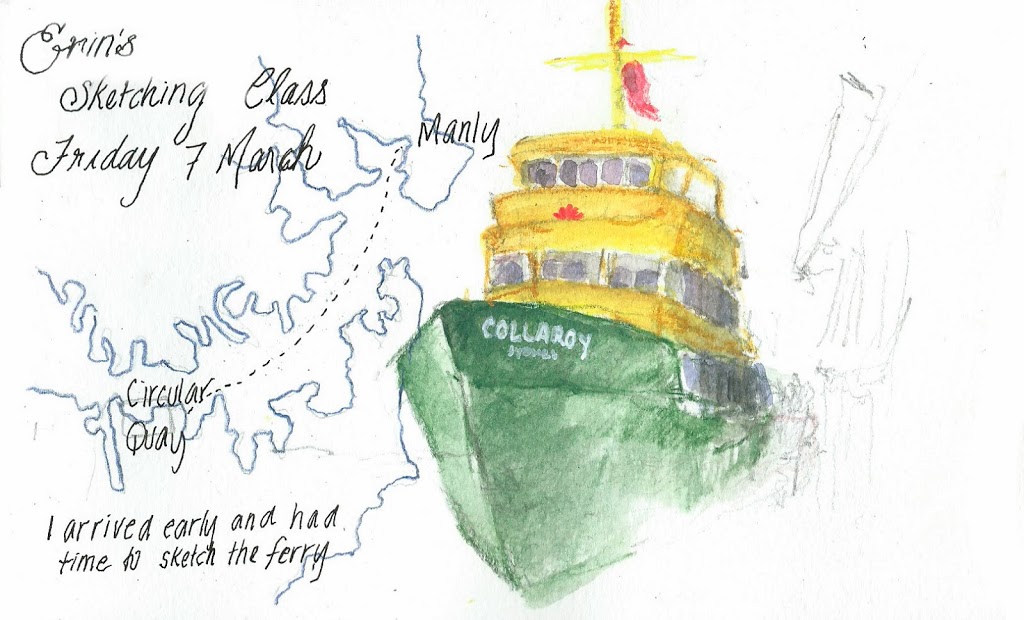
I sketched the basics of this page as I sat on the ferry going from Circular Quay to Manly. I knew I had eight minutes before the ferry sailed . I added the colour on the ferry ride out to Manly. Would I have done this if I was with non sketchers? probably .
 
I left a space on the left hand side as I know that I want to spend time at home drawing my old, folded bus timetable that I used. 
 
 
I also left space on the right hand side of the page as I knew that I wanted to draw a map of my journey. I drew it from Google maps when I got home. I drew it in ink, as the main feature of the page has enough colour.
 
 
updated version with bus timetable. drawn at home (while watching tv)
 

 The theme this week for Erin’s class was Barb’s birthday cake (I have never met Barb. She is a Friday sketcher- Happy Birthday !) I did not get a chance to finish the balloons as we had to leave to go to lunch.

But that does not matter – capture the moment on the page, as life around does not wait for you to draw it before it moves on.

and you don’t have to “finish” a page

Lunch at the Sugar Lounge in Manly . The sketching lessons continue through lunch from Erin as we sketched our food, table accessories, other people, or for me – the lights above. They look just like upsidedown birdsnests !

USK Barcelona DAY 1 Luis Ruiz Workshop

The Urban Sketching Symposium is a three-day workshop at which artists from around the world meet to draw and learn together in the host city. It includes field sketching sessions, lectures, panels, exhibits and artists demos. Symposium participants get one-on-one interaction with local and international workshop instructors coming to the host city from every corner of the world.

Barcelona was the host city of this year’s event in July. Past Symposiums were held in Santo Domingo (2012), Lisbon (2011), and Portland, USA (2010)

Urban Sketchers, is a non-profit organization dedicated to raising the artistic, educational and storytelling value of on-location drawing, promoting its practice and helping sketchers around the world connect with each other.
In Sydney on March 25 in Sydney Liz, Chris & I synchronized our watches and stayed up til midnight to be one of the 150 participants to register and enroll in the workshops. Lots of emails between us all and Esther in Edinburgh ! But what a buzz

Symposium attendees chose up to five urban sketching workshops out of a rich menu that covers a wide range of subject matter, including perspective and architecture, picture design, storytelling and reportage, color techniques and more.

 What workshops I chose and why

Each workshop was well described on the website before and had stated goals In the end I successfully enrolled in workshops that I thought would help me build and grow my urban sketching knowledge. There were instructors whose art and blogs I had enjoyed and admired so much. However, some of them were teaching workshop themes that I did not want to learn in those three precious days. I managed to say hello to them at some time during the Symposium.

I took something valuable away from each workshop I enrolled in . It may not have always been the main aim of the workshop (sorry instructors) , but I took something away. I heard it described a “CLICK” moment and I think this sums it up – Either confirming. establishing in words something I was aware of, and tightening it up, new concept -opening my eyes.

There were also pre-workshop Panel sessions, Demos and Lectures from 2-4pm . I made a decision for my health not to go to these but instead to go back to lovely hotel, relax and rest my feet and head–.I also was going back to the hotel at 9pm when others were heading out to dinner. It was the best choice for me.


Here are some short (3-4 min) YouTube videos  I found online that show  the Urban Sketchers Symposium. They give you an idea of what it was like ! Brilliant

Now  that I am home it is up to me to put all the my Workshop experiences into practice. Some of the CLICK moments I can see on my pages or I know that I when I am applying it in my drawing.

My extraordinary experience

DAY ONE

Day One began by going to the central CCCB centre and collecting the Symposium sponsor (ie goodies) bag and necktag with name in BIG LETTERS. You could spot a USK-er in the street and chat to them

.
 

We went back to our hotel to drop off out bag and I really didn’t get a chance to look though it properly til I got to London four days later) I had decided to use my usual Moleskine watercolor sketchbook everyday and do my workshops sessions a in a sponsors book, a specially embossed Stillman & Birn Heavy Weight Paper 150 gsm Ivory sketchbook that would take my watercolour pencils (the known) while learning the unknown. I did not want to challenge myself too much at once !

Then back to the Auditorium for the Opening Ceremony – a wonderful a warm welcome from the panel and Swasky. 

The we all headed  out to the  CCCB central forum that we would get to now so well. You then looked for your Workshop letter held in the air by the Instructor .

The workshops took place in emblematic Barcelona squares, streets and other public spaces such as Plaça Reial, Mercat de la Boqueria and Rambla del Raval, to name a few. Each workshop took 3 hours and was limited to a maximum of 17 participants) Each day had wonderful weather (except for that day it rained) It was 26 degrees – hat and sunburn cream each day.

DAY ONE AM

It was a thrill to be in the wonderful Luis Riuz’s workshop
I wish I had taken more notes on paper on the day, but I was too busy living the moment and soaking it all up.


Workshop I 10 – 1pm 
Actors and Stage
Instructor: Luis Ruiz
Location: Pla dels Àngels, MACBA


Description

Drawing in an urban context means being exposed multiple stimuli; the city is a complex environment from the visual point of view. You cannot capture on your sketchbook everything that is going on. It is perhaps preferable to select some story that has caught your attention and is worth to be told. The street and its architecture are the stage, and there each actor plays a role. And… actors are not always people! A building, a van, a dome or tower can play a role too.


Learning goals

  • Selecting what is important and what can be left out of the drawing.
  • Using the empty space of the paper as an active element.
  • Capturing the depth of the urban space: Actors play their role in the scenery.
  • Avoiding getting lost with the details. Do not draw everything!!
  • Leading the watcher’s eye to the desired place of the sketch

My Workshop Sketches

selecting what is important


Avoiding getting lost with the details. Do not draw everything!!

My Takeaway

Repetition – when sketching buildings down a street- don’t get lost in the details. Getting lost in the detail of architecture is something I struggle with and I now have a methods to put into place. For this sketch I did not even count the number of balconies and windows. Of course Sydney streets do not have those long buildings of Europe, but it is the concept that I can put in place.


The sketch above was THE BEST one hour –very self indulgent. At first, I thought that the washing and balcony was the feature of the little street, but it I realised it was the people in the street leading the eye. After getting the tight perspective right I added the people, then the repetition of he windows and balconies . Everything help directs the eye


Then we looked at each other sketchbooks – Amazing art by everyone!!
Then tapas lunch for all. I sketched mine of course (it was Esther’s as well, so she was patient to wait)


 all of my Barcelona sketches are on flickr